Lists
Lists Lists
Lists


Rosin, Stefanie, Alhasan, Omar, Thomson, Gill  ORCID: 0000-0003-3392-8182, Schulze, Daniel, Metze, Boris, Beuhrer, Christoph and Berns, Monika
(2026)
Prevention of early breastfeeding-related pain or complications by antenatal education on Biological Nurturing through film: A real-life parallel quasi-randomized controlled trial embedded in the German BALANCE cohort study.
Journal of Human Lactation
.
ISSN 0890-3344
ORCID: 0000-0003-3392-8182, Schulze, Daniel, Metze, Boris, Beuhrer, Christoph and Berns, Monika
(2026)
Prevention of early breastfeeding-related pain or complications by antenatal education on Biological Nurturing through film: A real-life parallel quasi-randomized controlled trial embedded in the German BALANCE cohort study.
Journal of Human Lactation
.
ISSN 0890-3344
Preview |
PDF (AAM)
- Accepted Version
376kB |
![[thumbnail of Figure 1]](https://knowledge.lancashire.ac.uk/id/eprint/59893/3/Figure1%20%28002%29.jpg "Figure 1") 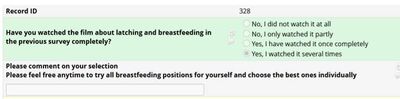 Preview |
Image (JPEG) (Figure 1)
- Supplemental Material
20kB |
![[thumbnail of Figure 2]](https://knowledge.lancashire.ac.uk/id/eprint/59893/4/Figure2%20%28002%29.jpg "Figure 2") 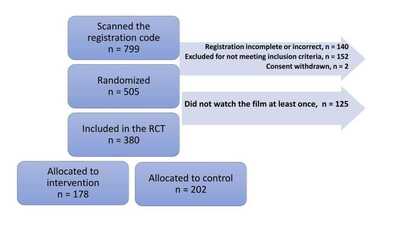 Preview |
Image (JPEG) (Figure 2)
- Supplemental Material
33kB |
Official URL: https://us.sagepub.com/en-us/nam/journal/journal-h...
Abstract
Background: Despite growing recognition of its importance, effective breastfeeding support remains limited worldwide. A meta-analysis on the effectiveness of Biological Nurturing or the laid-back position revealed its efficacy to prevent early breast problems.
Aim: To elicit whether a film on Biological Nurturing (intervention), compared to a film on traditional breastfeeding positions (control), watched during pregnancy, reduced breast problems and increased the exclusivity of breastfeeding at initiation stage.
Methods: A real-life parallel quasi-randomized controlled trial embedded in a prospective cohort was conducted, using an online survey administered through REDCap software with alternating group allocation. Survey items were both quantitative and qualitative, with data collected at TR (registration), T0 (birth to 21 days) and T1 (22-42 days). SPSS 31.0 was used to calculate Chi square, Mann-Whitney-U-test, median and frequencies. Google Gemini was used as an assistive tool for preliminary categorization and translation support of qualitative data, while final coding, interpretation and validation were performed by the research team. Primary outcomes were breast problems and exclusive breastfeeding at 3 weeks postpartum.
Results: 380 participants provided data for the study. The intervention group showed a lower incidence of any breastfeeding-related problems at 3 weeks postpartum, measured at T0 (p=0.002) and T1 (p=0.03). However, there was no significant difference in exclusive breastfeeding at 3 weeks postpartum (p>0.1).
Conclusion:. While this study contributes to growing evidence on Biological Nurturing reducing early breast problems and the effectiveness of antenatal education, its lack of effect on early exclusive breastfeeding highlights the ongoing need for skilled breastfeeding support.
Repository Staff Only: item control page
 https://orcid.org/0000-0003-3392-8182